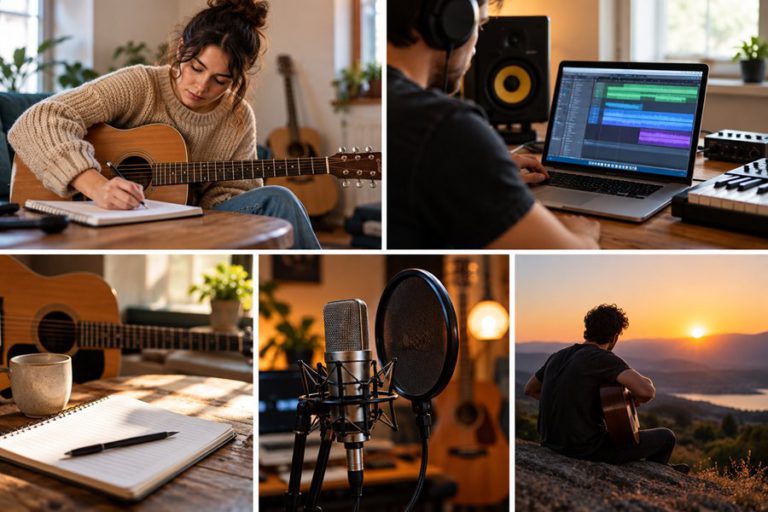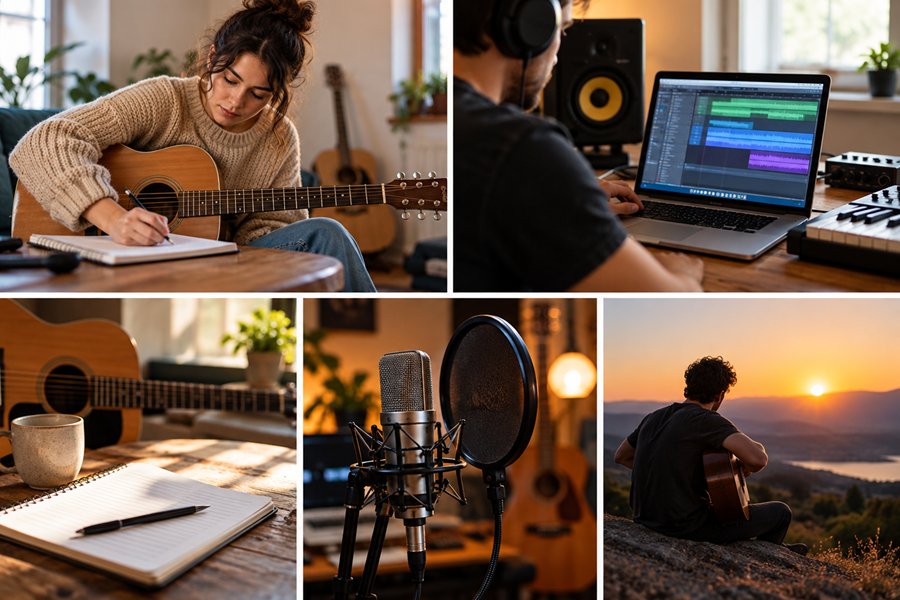
Starting a song can happen in seconds. A melody appears while driving, a lyric lands in the notes app, or a chord progression suddenly feels worth exploring.
Contents
- Identify Where Your Songs Usually Stall
- Give Each Writing Session a Clear Objective
- Turn Practice Into Deliberate Skill Development
- Learn to Separate the Song From the Production
- Create a Definition of “Finished”
- Conclusion
Finishing that song is another matter.
Many songwriters accumulate fragments—verses without choruses, promising demos, half-written hooks—not because they lack creativity but because inspiration alone does not provide a process for turning ideas into completed work. Developing a repeatable workflow can make songwriting more productive without making it mechanical.
Identify Where Your Songs Usually Stall
Before changing your creative process, figure out where it tends to break down.
Some writers generate plenty of ideas but struggle to develop them. Others can create verses yet have trouble writing a chorus that feels distinct. A songwriter may finish lyrics and melody but become stuck when arranging or recording the track.
Review several unfinished songs and look for patterns.
Do most stop after the first verse? Do you constantly rewrite lyrics without committing to a version? Does production begin before the underlying song is finished?
Identifying the bottleneck makes practice more useful. Instead of vaguely trying to “write better songs,” you can work on the specific stage that consistently causes trouble.
It also helps to separate writing from judging. Trying to create and criticize every line simultaneously can slow progress. Drafting freely and evaluating afterward gives ideas room to develop before deciding what deserves revision.
Give Each Writing Session a Clear Objective
A common reason songwriting sessions become frustrating is that the goal is too broad. “Finish my song” may involve melody, lyrics, harmony, arrangement, recording, editing, and production.
Smaller objectives are easier to complete.
One session might focus exclusively on generating chorus melodies. Another could be devoted to replacing weak lines in the second verse. A third might explore whether the song needs a bridge.
Breaking the process into stages also makes it easier to recognize progress.
A useful workflow might move through:
idea capture → song development → structural editing → arrangement → demo → revision → final production.
Not every songwriter needs to follow those steps in precisely that order. The point is to establish enough structure that you know what you are trying to accomplish each time you sit down to work.
Constraints can help too. Limiting yourself to three chords, writing from a specific point of view, setting a temporary lyric deadline, or composing a melody before touching an instrument can prevent endless decision-making.
Turn Practice Into Deliberate Skill Development
Writing more songs is valuable, but volume alone does not guarantee that weak areas will improve.
If your melodies repeatedly sound similar, deliberately study phrasing, interval choices, and rhythmic variation. If lyrics are the problem, practice concrete imagery, rhyme, prosody, and point of view separately from composing complete songs.
Feedback can be equally important. Songwriters working entirely alone can become accustomed to their own habits and may struggle to recognize weaknesses in structure, lyrics, arrangement, or production.
For writers who want a more organized approach, following a structured songwriting course online can provide a framework for developing skills across several stages of the process rather than learning each element through trial and error alone.
The key is deliberate practice. Whether skills are developed through formal instruction, collaboration, self-study, or a combination of methods, practice works best when it has a specific purpose.
Instead of writing another complete song every time, spend some sessions writing ten chorus hooks. Rewrite one verse from three different perspectives. Build several arrangements around the same composition. Record alternative versions of a vocal melody.
Focused repetition makes weaknesses easier to identify and improve.
Learn to Separate the Song From the Production
Modern songwriting and production frequently overlap. That can be creatively useful, but it also creates another place to get stuck.
A writer may spend an hour searching for the perfect snare sound while the chorus still needs work.
When production decisions begin consuming the writing session, ask whether the choice actually affects the composition. Chords, melody, lyrics, rhythm, form, and arrangement usually deserve attention before minor sonic details.
A simple demo can often reveal whether a song works without elaborate production.
At the same time, songwriters benefit from understanding how recording and arrangement affect their compositions. A lyric that looks effective on paper may feel crowded when sung. A chorus may need fewer words to accommodate a stronger melody. An arrangement may expose sections that continue too long or do not contrast enough.
Production should therefore support the song rather than distract from finishing it.
Create a Definition of “Finished”
Perfection is an unreliable finish line.
There will almost always be another lyric that could be tested, another sound that could be changed, or another vocal take that might improve the recording. Without a clear stopping point, revision can continue indefinitely.
Define what finished means before reaching that stage.
For a writing demo, finished may mean complete lyrics, melody, chords, structure, and a recording clear enough to communicate the song. A release-ready track requires a much higher production standard.
Setting the appropriate standard prevents every composition from becoming an endless project.
It is also useful to archive completed songs rather than constantly reopening them. Lessons from one project can be applied to the next instead of repeatedly rebuilding the same track.
Conclusion
Songwriting depends on creativity, but consistency becomes much easier when creativity is supported by a repeatable process.
Identify where songs tend to stall, divide writing into manageable stages, practice individual weaknesses deliberately, and avoid letting production details interrupt unfinished compositions. Most importantly, decide what “finished” means for each project.
A useful songwriting process should not restrict experimentation. It should remove enough friction that promising ideas have a better chance of becoming completed songs.
Key Points
- Many songwriters struggle to finish songs due to a lack of a structured process, leading to an accumulation of unfinished fragments.
- Identifying specific bottlenecks in the songwriting process can help songwriters target their practice and improve productivity.
- Setting clear, smaller objectives for each writing session makes it easier to achieve goals and recognize progress in the songwriting process.
- Deliberate practice, focusing on specific skills such as melody or lyric writing, can help songwriters improve weak areas more effectively than merely writing more songs.
- Separating the songwriting process from production can prevent distractions that may hinder progress on song composition.
- Defining what ‘finished’ means for a song can help avoid endless revisions and promote the completion of songwriting projects.
About the Author